

|
Langkawi-Nature.com
Explore
and discover the hidden beauty
Welcome to langkawi-nature.com
which is the website of Dev’s Adventure Tours,
located on the legendary isle of Langkawi in Malaysia.
Langkawi is a place for those seeking
tranquility and refuge from the hustle and bustle of
city life. Dev’s Adventure Tours gives you the
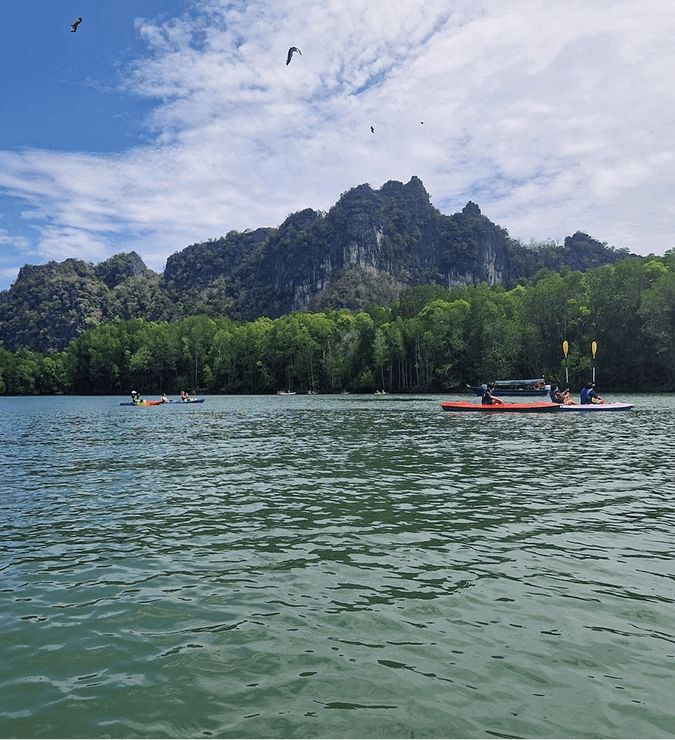
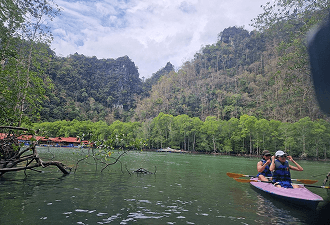
opportunity to explore Langkawi’s natural beauty
in an adventurous way.
On this website you will find a lot
of information about the nature site of Langkawi, where
Dev’s Adventure Tours is providing professional
eco tours. |
From Dev's
Desk
February 2010
We are in the middle of the dry season and that is what you can see all around you on Langkawi. The heat is taking its toll on the deciduous trees and they are dropping their leaves. The lack of rain is a kind of emergency situation for the trees and this will lead to flowering soon.
 |
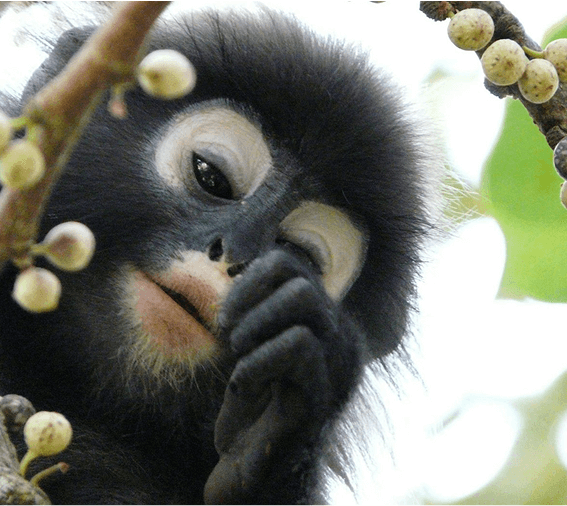
Thirsty Dusky-Leaf Langurs |
For animals the dry season can have its disadvantages too as they have to look harder to find water sources and this will lead more often of spotting for example monkeys in the villages trying to get some water.
As this is also peak season for Langkawi with many guests coming in, they are all enjoying the sun, the high temperatures and the lack of rain as this was for most of them exactly what they were looking for. There is no worry about the weather situation and all trips can go on as planned.
Read more...
December 2009
 |
Dingos |
After the information of the sighting of the whale sharks in October a lot of boats have gone out to try to spot these amazing animals and there were only a few boats that came back with positive news and many others were not that lucky. As the whale sharks are migratory and might visit the Langkawi archipelago from December till March many more times we just have to be patient and wait for a next opportunity.
LIMA has just finished and many people have enjoyed looking at the various planes and boats that were exhibited during this show but we always wonder what the effect of the noise will be to the animals and especially the birds. As the dry seasons is almost there, more migratory birds have come in and bird watching will be a lot of fun during the next dry months. The Oriental Scops Owl is back in the mangroves and can be spotted during our mangrove boat trip and we are happy to see that the numbers of various raptors and Wreathed Hornbills are slowly increasing. I have also spotted last month a jungle owlet and a spotted owlet and both species are not common on Langkawi. One of them I could save out of my cats’ mouth so I had time enough to determine that it was a jungle owlet.
Read more...
October 2009 – extra
An extra column this month as we would like to share the experience of our good friend Naylene. We received the following mail including photos from her a couple of days ago:
I went fishing yesterday with some friends in front of the Berjaya and we spotted at least 5 Whale sharks at approx. 11:30 a.m.!! Amazing experience!!!! I imagine we spent about 2 hours with them - I'm still so excited and just had to share these (amateur!) photos with you - lucky I had my camera with me, or maybe no one would believe this experience! Don't ask me how big they were, but all I know is that we were in a 25ft. Explorer Speedboat, and the whale sharks were MUCH bigger than the boat!! They swam underneath the boat, swam all around us, and gave us a real show. After that, we really didn't care if we caught any fish!! We reckon we already had the catch of the day!
|
|
Whaleshark - by Naylene Vuurens - Smith |
Read more...
October 2009
While writing this we are in between the Hari Raya Aidilfitri and Deepavali break for our Asian guests and in between the summer break and autumn break for many other countries and this is always a period full of surprises for us. Some days all the trips are fully booked, some days we have 4 trips going out with only a few people per trip; we always try to accommodate as many guests as possible but we would like to stick to certain maximum numbers per trip. We always recommend advance bookings, especially for short stay guests who are not flexible in changing days due to their tight schedule. Check out our eco-packages elsewhere on this website where you will be rewarded with a discount by booking more than 1 trip with us during the same stay. The combinations of the eco-packages can be done on 1 day for certain combinations, but we usually recommend to spread the eco-package out over more days.
|
|
Spathoglottis Alba |
Habenaria |
Read more...
August 2009
 |
Oriental Pied Hornbill (Photo by Helen and Ben Brewster) |
We are in the middle of the summer break for parts of the world which means a lot of families with children on our trips. It is great to have children on the trips as they seem to be very interested in seeing animals, plants, flowers and trees that they will not see in their own country. Especially the trips in the mangroves are popular; by boat or by kayak and for a lot of children the jungle trekking / evening walk combination is a highlight with the flying lemurs and squirrels.
During some bird watching trips last month we have seen the first grey wagtail. It seems that the migratory birds are coming in a bit early. A very popular place for spotting some good birds is the area of and around the Bon Ton and of course the Gunung Raya is still a good place for spotting the three species of hornbills. In the Pantai Cenang area we have seen the Baillon's Crake, which we have listed as a passage migrant. It is very similar to White-browed Crake, but it is slightly smaller and does not have the brow; it also has a whitish throat and belly.
Read more...
June 2009
We have been busy outdoors and on trips the last weeks; the local school holidays brought a lot of people from other parts of Malaysia and Singapore to our beautiful island. Especially the well priced new direct flights from Singapore to Langkawi are used often and we have seen an increase of Singaporean guests. The weather has been good for the tourists, which means hot and dry, but we could do with some rain once in a while to keep it all nice and green.
I have finally spotted the not so common Nervilia calcicola, an orchid species. This personally gives me a lot of pleasure because I could not recognize this plant as an orchid and now, after finding it, it has been embedded in my brain. This hexagonally shaped leafy plant is found about 2 or 3 meters above the water line and I came across it at high tide on one of our kayaking trips. After carefully pulling it out of loose soil, I could clearly see the awkward looking bulb and confirm that it is indeed the mentioned species. After carefully placing it back and taking note of the surrounding area, one could see that the plant was growing in a horizontal crevice. Now it will be a matter of time to await the flowering to make some more records and photos. This orchid is endemic to Langkawi and not found anywhere else. Therefore mentioning this plant in other states could help us update a taxonomical list. Please do forward any information to us if you have.
Read more...
April 2009
We are very happy to inform you that the Malaysian Nature
Society (MNS) has started a branch on Langkawi. The official
launch was on 21 April 2009. Having an own branch on the island
is definitely more effective than being part of the Kedah
branch on the mainland. This will give more punch and more
say to nature lovers and conservationists on the island and
hopefully a lot of environmental issues can be treated in
a different way and also from the nature and conservation
point of view. Our company is supporting the new branch wherever
we can.
At the moment a lot of dusky leaf langur babies are changing
their colour. The babies are born with a bright orange colour
and this will change after about six months.
Read more...
March 2009
The real
dry season is over and we have daily short and heavy rain
showers. As everywhere in the world the climate is changing
and we only had 2 full dry months this dry season
instead
of 3 or 4 months. We always get a lot of questions about the
weather conditions in relation to our trips. Please realise
that the rain is mostly short and heavy and after that the
conditions are perfect to do a trip. Having rain in the area
of your resort does not automatically mean that it will be
raining at the starting point of your trip. We always recommend
you to come to the starting point of the trip, unless we foresee
no improvement. If you are at the starting point and you will
still decide not to join the trip with us, we will send you
back without any charge for trip or transfer. Let not your
day be spoilt by some rain; conditions can change very quickly
and you might be missing a wonderful day out.
Our friend
and wildlife photographer Tom Reynolds has managed to get
a photo of the slow loris, one of the four monkey species
on Langkawi. Lorises are mainly solitary, active at night
and you might be able to spot one by shining a light through
trees and looking for reflective eyeshine. They walk slowly
and deliberately through trees and on wires but can move quickly
when catching a prey. Diet comprises insects, birds, small
mammals and lizards, as well as fruit, nectar and pollen.
An adult weigh 1-2 kg and is 30-38cm.
Read
more...
February 2009
We
are in the middle of the dry season and it is really dry at
the moment. Is has also been very hot on Langkawi the last
weeks and we really welcomed the short rain showers we had
in the evenings the last few days. It was a real refreshment
for men and nature and the views during the trips are so much
clearer and brighter the following day. The hot weather is
turning the limestone vegetation dry and brown like trees
in autumn and falling leaves are everywhere. The mangrove
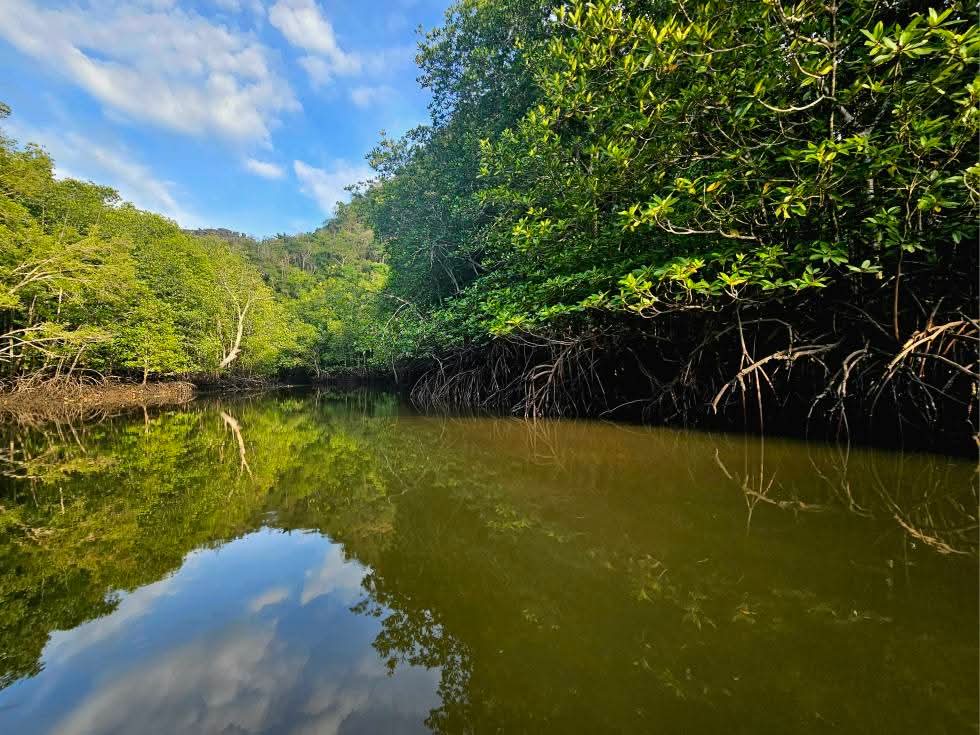
forests however are evergreen which provides a nice contrast
in the scenery and during one of the mangrove trips you will
hardly realise that we are in dry season.
One of
the drawbacks of the dry season are the bush fires and we
are definitely not happy with this at all. Local people are
torching bush to clear land which will finally have disastrous
consequences for the nature and environment in the future.
Read
more...
|